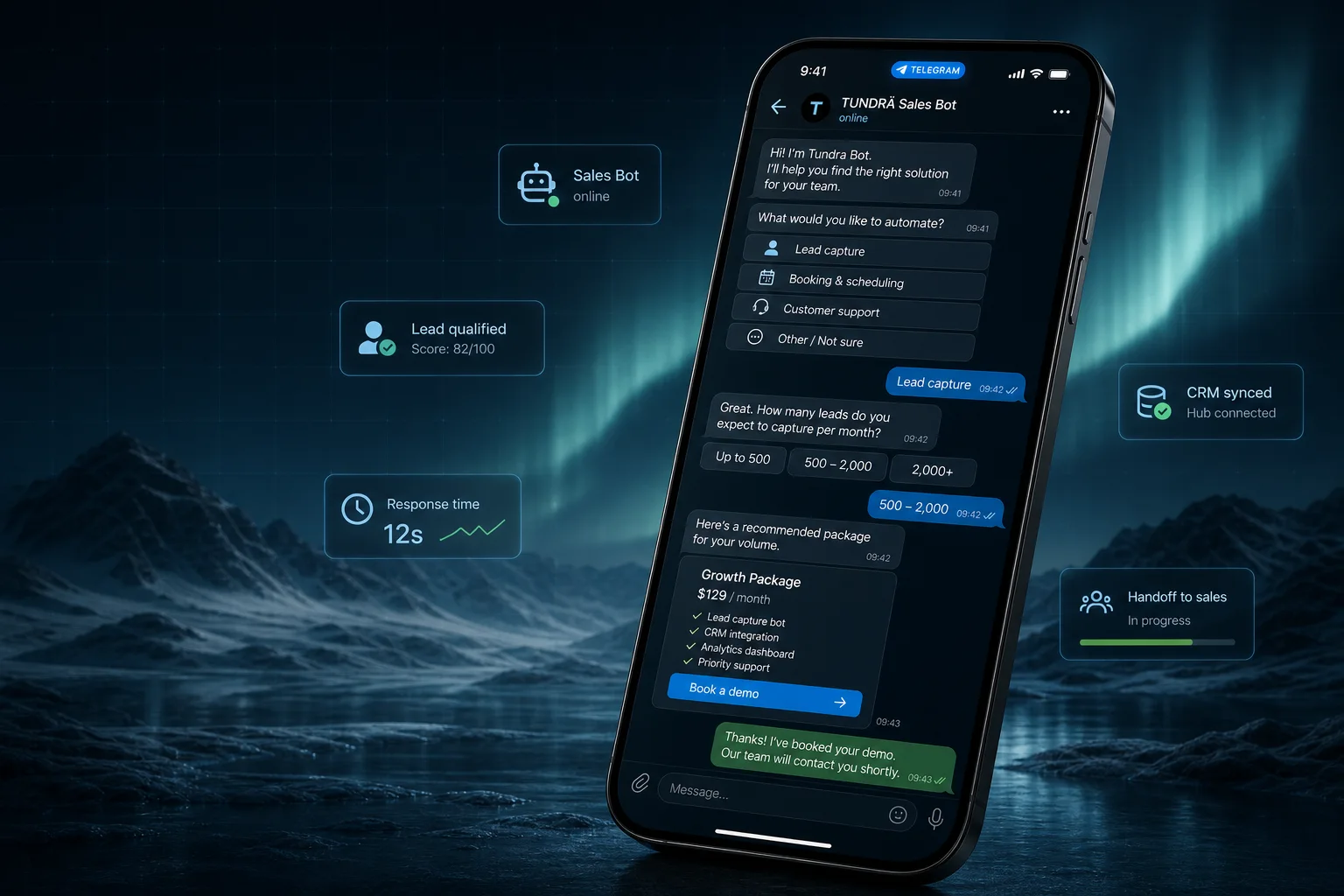
AI chatbot development
Build an AI chatbot that knows when to answer, ask, or hand off.
TUNDRÄ builds AI chatbots trained on your business content for support, lead qualification, bookings, summaries, and routing across website chat, Telegram, WhatsApp, and internal workflows.
- Business-trained answers
- AI guardrails
- Human handoff
- CRM and analytics
AI chatbot development Live scope preview
Scope Ready for estimate
Scope
AI chatbots fail when they are treated like generic answer boxes.
A useful AI chatbot needs source content, retrieval or prompt rules, conversation design, escalation, logging, and ownership. The goal is not to answer everything. The goal is to handle the repeatable work safely.
- Answer from approved website, FAQ, product, policy, and support content.
- Qualify leads, collect missing details, summarize conversations, and route the next step.
- Use fallback, refusal, and handoff rules when the answer affects trust, money, safety, or compliance.
AI workflows
Start with one AI job, not every possible conversation.
The safest first release gives AI a narrow job, approved sources, and a clear path when the conversation leaves that job.
AI support assistant
Answer common service, product, onboarding, and policy questions from approved source material.
- FAQs
- Docs
- Policies
- Fallback
AI lead qualifier
Ask fit questions, capture details, summarize intent, and route the lead to sales or CRM.
- Fit check
- Intent
- Summary
- CRM route
AI booking assistant
Collect service type, preferences, constraints, and contact details before calendar or staff handoff.
- Service
- Preferences
- Availability
- Reminder
Internal knowledge bot
Help staff find policies, procedures, product details, and operational answers with access-aware boundaries.
- Procedures
- Search
- Permissions
- Review
Production controls
Reliable AI needs more than a model connection.
Most of the work is deciding what the bot can know, what it can say, what it should not say, and how people review failures.
Approved source set
Clean source content reduces wrong answers and keeps the bot aligned with current products, policies, and prices.
- Website
- Docs
- FAQs
- Policies
Guardrails and refusals
The bot needs rules for uncertainty, sensitive topics, out-of-scope requests, pricing, legal claims, and escalation.
- Uncertainty
- Refusals
- Escalation
- Tone
Review loop
Fallback topics, bad answers, handoff reasons, and conversions should be visible after launch.
- Fallbacks
- Bad answers
- Handoffs
- Conversions
AI readiness
The source quality decides how ambitious the AI bot can be.
A bot trained on clean docs can answer more. A bot trained on scattered claims should start with qualification and handoff.
| Readiness level | Source state | Safe first workflow | Avoid at launch |
|---|---|---|---|
| Low | Few FAQs, outdated pages, unclear policies | Lead intake, routing, basic scripted answers | Open-ended AI support claims |
| Medium | Useful pages and FAQs, but gaps in edge cases | AI Q&A with fallback and human handoff | Taking payments or promising exact policy outcomes |
| High | Clean docs, owners, examples, review process | AI support, qualification, summaries, and recommendations | Removing humans from sensitive exceptions |
| Regulated or sensitive | Medical, legal, financial, employment, or account-risk topics | Intake and routing with careful disclaimers | Automated advice or final decisions |
Source checklist
Prepare these before asking AI to talk to customers.
Good AI chatbot estimates are based on sources, risk, channels, and handoff, not only model choice.
| Input | Ready example | Why it matters |
|---|---|---|
| Source material | Website pages, FAQs, policies, product docs, pricing notes | Defines what the AI can answer |
| Forbidden topics | No legal advice, no medical guidance, no discounts, no account promises | Prevents risky overreach |
| Handoff rules | Escalate angry users, VIP leads, refunds, compliance, unknown answers | Keeps humans in control of edge cases |
| Channel | Website chat, Telegram, WhatsApp, Instagram, internal tool | Changes UX, API, cost, and permission planning |
| Review owner | Person who checks failed chats and approves content updates | Keeps the bot useful after launch |
Bot type
FAQ bot, AI assistant, or AI agent?
The label matters less than the responsibility. Do not give the bot more autonomy than the workflow can safely support.
| Type | Best for | Risk | TUNDRÄ view |
|---|---|---|---|
| Scripted FAQ bot | Small set of predictable questions and answers | Rigid when users phrase things differently | Use when accuracy matters more than flexibility |
| AI assistant | Support Q&A, lead qualification, summaries, routing | Wrong answers without sources and guardrails | Best first AI chatbot for most businesses |
| AI agent | Multi-step internal tasks with tool calls and approvals | Can create operational risk if unsupervised | Use only with scoped tools, logs, and human approval points |
| Human-only inbox | Sensitive, low-volume, or relationship-heavy conversations | Slow replies during peaks | Keep when automation would damage trust |
Packages
Price AI by risk, sources, and integrations.
A simple AI website assistant is not the same as an AI workflow that touches CRM, payments, booking, account data, or support operations.
AI chatbot trained on business content
For one channel, source-based answers, lead capture or support triage, fallback, and human handoff.
from USD 1,000-3,000 2-7 days
- Source prep
- Prompt rules
- Widget or bot
- Fallback logs
- Handoff
AI chatbot with CRM, booking, or support routing
For AI workflows that need lead scoring, booking routes, private APIs, customer context, or analytics.
from USD 2,500-7,000+ 1-3+ weeks
- CRM sync
- Booking route
- Private API
- Conversation summaries
- Analytics
AI chatbot audit and repair
For bots that hallucinate, over-answer, miss handoff, have bad prompts, or use messy source content.
fixed audit, then repair quote 48h-1 week
- Prompt audit
- Source review
- Guardrails
- Failure logs
- Repair plan
Accuracy
Source-first AI is safer than prompt-only AI.
The more important the answer, the more the bot needs curated sources, retrieval boundaries, refusal rules, and review logs.
Clean content beats clever prompts
The bot should answer from current, approved material rather than guessing from a vague system prompt.
- Current docs
- Approved claims
- Examples
- Owners
Uncertainty needs a designed response
The bot should say when it is unsure, ask a clarifying question, or hand off instead of sounding confident.
- Clarify
- Refuse
- Escalate
- Log
Bad answers should become fixes
Every fallback and handoff reason can improve the source content, prompt, or page copy.
- Review queue
- Source update
- Prompt tune
- Page update
Channels
AI can live on the website, Telegram, WhatsApp, or inside operations.
The same knowledge layer can support different channels, but each channel has its own UX, permissions, costs, and handoff path.
On-site AI assistant
Best for visitors comparing services, pricing, docs, or support content.
- Page context
- Lead capture
- Support deflection
- Analytics
Telegram or WhatsApp AI bot
Best when customers already ask questions in chat and need follow-up after the site visit.
- Chat UX
- Handoff
- CRM route
- Message costs
Staff assistant
Best for operations teams that need answers, summaries, and routing from internal knowledge.
- Permissions
- Procedures
- Summaries
- Audit trail
Comparison
AI chatbot vs normal chatbot
AI is useful when users phrase questions differently or need guidance. It is overkill when the workflow is a short fixed form.
| Option | Best for | Risk | TUNDRÄ view |
|---|---|---|---|
| Scripted bot | Simple lead forms, menu choices, notifications, fixed booking intake | Poor handling of unexpected wording | Use when the path is predictable |
| AI chatbot | Q&A, qualification, support, recommendations, summaries | Needs sources, guardrails, and review | Use when language flexibility matters |
| Hybrid bot | Critical flows where AI answers but buttons control important actions | More design work than pure script or pure AI | Often the best production pattern |
Process
AI chatbot development process
We scope the job first, then build a controlled AI workflow that can be reviewed, improved, and handed off.
Define the AI job
Support, qualification, booking, summary, recommendation, internal lookup, or rescue.
Prepare sources and boundaries
Collect approved content, forbidden topics, fallback rules, and escalation triggers.
Build and connect
Implement prompt logic, retrieval or source loading, channel UI, CRM or handoff, and analytics.
Test and review
Test realistic conversations, wrong inputs, risky topics, handoff, and post-launch improvement loops.
FAQ
AI chatbot questions before production.
Will the AI chatbot hallucinate?
Any AI system can be wrong. The practical way to reduce risk is to use approved sources, narrow the job, add refusal and escalation rules, log failures, and review real conversations.
Can it be trained on our website?
Yes. Website pages, FAQs, docs, policies, product details, and examples can be used as source material. The quality and freshness of those sources matter.
Can the same AI work on website, Telegram, and WhatsApp?
Often yes at the logic level, but each channel needs its own UX, API setup, cost assumptions, and handoff route.
Do we need AI for lead capture?
Not always. A scripted lead flow is better when the questions are fixed. AI helps when visitors ask varied questions before they are ready to leave contact details.
Next step